
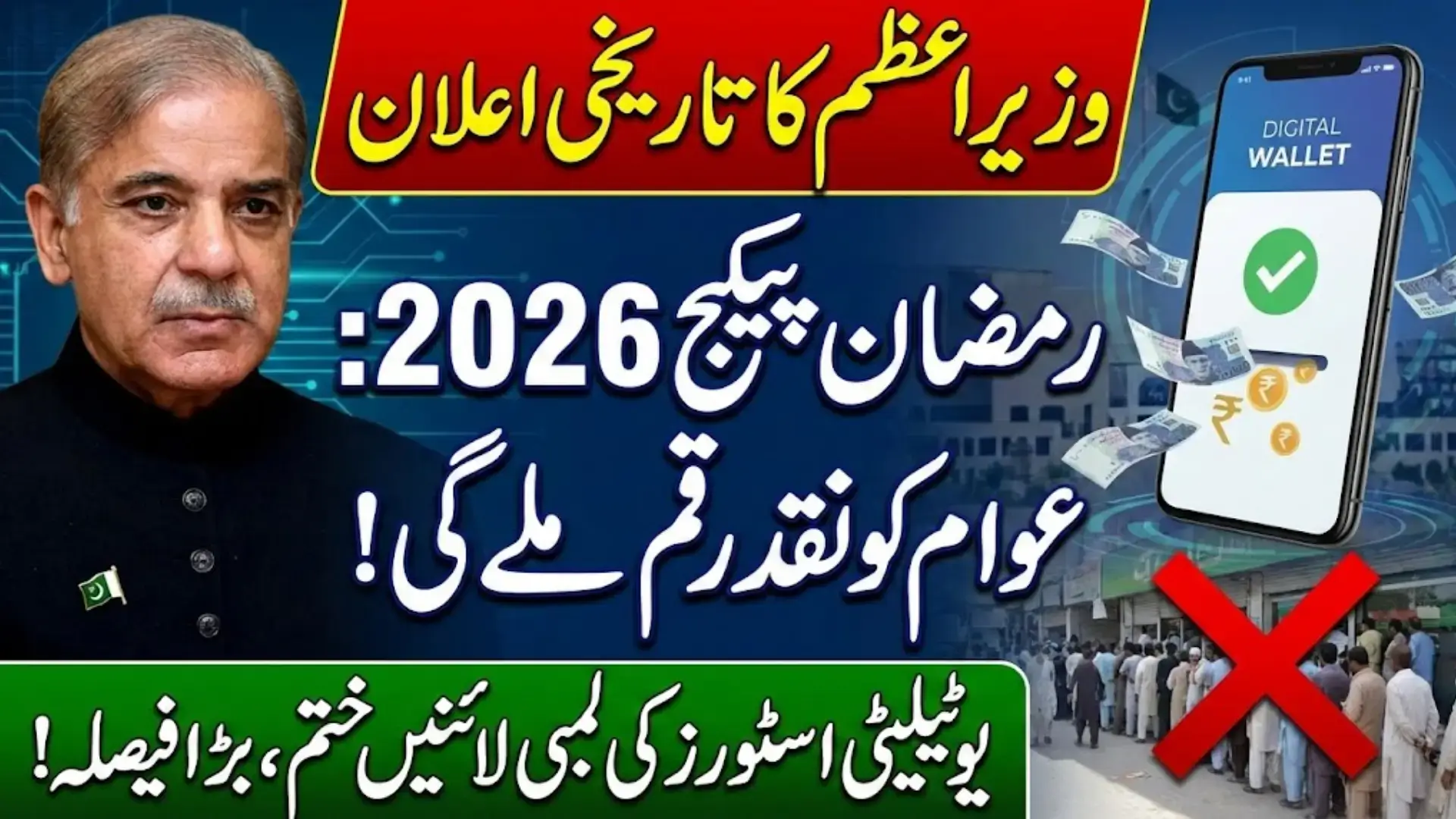
Prime Minister Ramadan Package 2026
Prime Minister Ramadan Package 2026 in Pakistan is not only a month of worship but also a time when millions of low-income families struggle to manage rising food prices and daily expenses. Keeping this reality in mind, Prime Minister Shahbaz Sharif has directed authorities to prepare a more effective, people-centered Ramadan Package for 2026. The aim is to ensure that government support reaches deserving citizens in a respectful and transparent way.
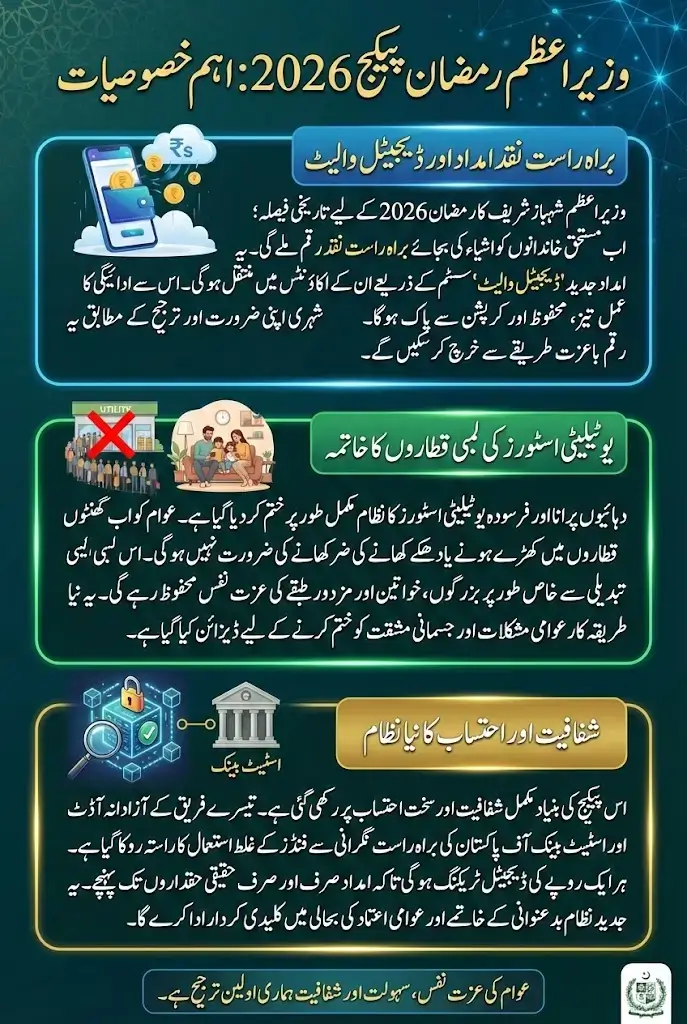
Over the years, I have personally seen how people stood in long queues outside utility stores, often returning home empty-handed. This time, the government appears determined to change that experience. The new strategy focuses on direct financial assistance, digital systems, and strong monitoring so that relief is timely, fair, and corruption-free.
Review of Last Year’s Ramadan Package Performance
During a recent meeting chaired by the Prime Minister, officials presented a detailed review of the third-party validation of last year’s Ramadan package. The report confirmed that the program was implemented without financial corruption or administrative negligence, which is a rare but welcome development in public welfare initiatives.
The briefing highlighted that independent audits and strict oversight helped maintain transparency. According to the Prime Minister, this clean report proved that when systems are designed properly, public money can reach the poor without misuse. This successful experience has now become the foundation for planning the Ramadan Package 2026.
Key findings from last year’s review included:
- No evidence of financial corruption
- Smooth administrative execution
- Positive feedback from beneficiaries
- Effective role of independent audit institutions
You Can Also Read: Division-Level Position Holders’ Results in Sports and Co-Curricular Activities By PEEF 2026
End of the Old Utility Store Distribution System
For decades, Ramadan relief in Pakistan was linked to utility stores, a system that faced constant criticism. People complained about limited stock, favoritism, and long waiting hours. Recognizing these problems, the federal government has officially ended this outdated mechanism.
The Prime Minister explained that the utility store-based relief system was not only inefficient but also disrespectful to the poor. By abolishing it, the government has removed a major source of public dissatisfaction. The new approach focuses on direct assistance, where citizens do not have to beg or wait for hours to receive basic support.
Major shortcomings of the old system were:
- Unequal access to subsidized items
- Opportunities for corruption and hoarding
- Physical hardship for elderly and women
- Lack of transparency in distribution
Government’s Commitment to Transparency and Accountability
Transparency has been declared the backbone of the Ramadan Package 2026. The Prime Minister praised the role of the authoritative audit institution, which verified the fairness of the previous package. According to him, public trust can only be restored when accountability is visible and continuous.
The government has adopted a system where every rupee spent can be traced. This is a major shift from past practices, where welfare funds often disappeared without explanation. The Prime Minister stressed that administrative discipline and clean governance are not optional but essential.
Key transparency measures include:
- Third-party audits
- Digital payment tracking
- Centralized monitoring systems
- Clear institutional responsibilities
Digital Wallet System for Ramadan Cash Assistance
One of the most important decisions for Ramadan 2026 is the use of digital wallets for cash assistance. Instead of giving subsidized goods, the government will provide direct cash support, allowing families to spend according to their needs.
This system respects the dignity of citizens. People will no longer have to stand in public lines or prove their poverty repeatedly. From my observation, this is especially beneficial for women, daily wage workers, and elderly citizens who often suffer the most during Ramadan.
Benefits of digital wallets include:
- Direct transfer of relief funds
- Faster and safer payments
- Reduced human interference
- Increased financial inclusion
Promotion of a Cashless Economy in Pakistan
The Ramadan Package 2026 also supports the broader national goal of promoting a cashless economy. By encouraging digital transactions, the government is trying to bring more people into the formal financial system.
While this transition may take time, it offers long-term benefits for both the state and citizens. Digital payments help reduce undocumented money and make economic planning more effective. For many low-income families, this will be their first interaction with digital financial tools.
Role of State Bank in Monitoring Ramadan Funds
To ensure credibility, the State Bank of Pakistan will be directly involved in overseeing the digital payment process. Its role is to make sure that funds are transferred securely and without delays.
The State Bank’s involvement strengthens the overall system and minimizes the risk of technical failures. It also ensures coordination between banks, digital wallets, and government departments.
Responsibilities of the State Bank include:
- Ensuring secure digital transactions
- Supervising payment channels
- Supporting system integration
- Monitoring fund flow
Digital Dashboard for Real-Time Monitoring
A new digital dashboard will be developed to monitor the Ramadan package in real time. This system will allow authorities to track how many people have received funds and identify any issues immediately.
From a governance perspective, this is a powerful tool. It reduces guesswork and ensures that decisions are based on real data rather than assumptions. Such dashboards have already shown success in other government programs.
Expanding Access for Deserving and Low-Income Families
The Prime Minister has instructed officials to widen the scope of the Ramadan Package 2026 as much as possible. The goal is to include more poor and deserving families, especially those affected by inflation and unemployment.
This expansion reflects a shift toward inclusive policymaking. Instead of limiting relief to a small group, the government wants to reach households that are often ignored in traditional welfare programs.
Administrative Discipline in Relief Distribution
Strict administrative discipline has been emphasized to ensure smooth execution. Every department involved in the Ramadan package will be held accountable for its role.
Clear procedures, monitoring systems, and reporting mechanisms will help prevent delays and mismanagement. This structured approach is essential for a nationwide relief initiative.
Introduction of Social Protection Vault Under BISP
A major institutional reform discussed in the meeting was the introduction of a Social Protection Vault under the Benazir Income Support Program (BISP). This vault will act as a centralized system to manage welfare data securely.
It will improve coordination between different social programs and reduce duplication. Over time, this system can help Pakistan build a stronger and more reliable social safety net.
Complete Digital Disbursement from March 2026
From March 2026, all government relief funds will be distributed digitally. This marks a historic shift in Pakistan’s welfare system.
| Aspect | Old Relief System | Ramadan Package 2026 |
|---|---|---|
| Distribution method | Utility stores | Digital wallets |
| Transparency | Limited | Fully trackable |
| Public experience | Long queues | Direct cash transfer |
| Corruption risk | High | Minimal |
This transition is expected to improve efficiency and public satisfaction.
Prime Minister’s Instructions to Ministries and Institutions
The Prime Minister has directed all ministries and institutions to submit practical recommendations for improving the Ramadan package. This consultative approach ensures that policies reflect ground realities.
Such coordination also creates shared responsibility, reducing the chances of administrative failure.
Global Recognition of Ramadan Package Transparency
It was also revealed that a world-renowned audit firm declared the Ramadan package transparent and effective. This international validation confirms that Pakistan is moving in the right direction in managing public welfare funds.
The report stated that no financial irregularities were found, which enhances the credibility of the government’s social protection initiatives.
Conclusion
The Prime Minister Ramadan Package 2026 represents a meaningful shift toward dignity, transparency, and efficiency. By replacing outdated systems with digital solutions, the government aims to ease the hardships of ordinary Pakistanis during Ramadan.
As a journalist who has witnessed the struggles of people during previous relief drives, this new approach feels practical and humane. If implemented honestly, it can become a model for future welfare programs and strengthen public trust in state institutions.