
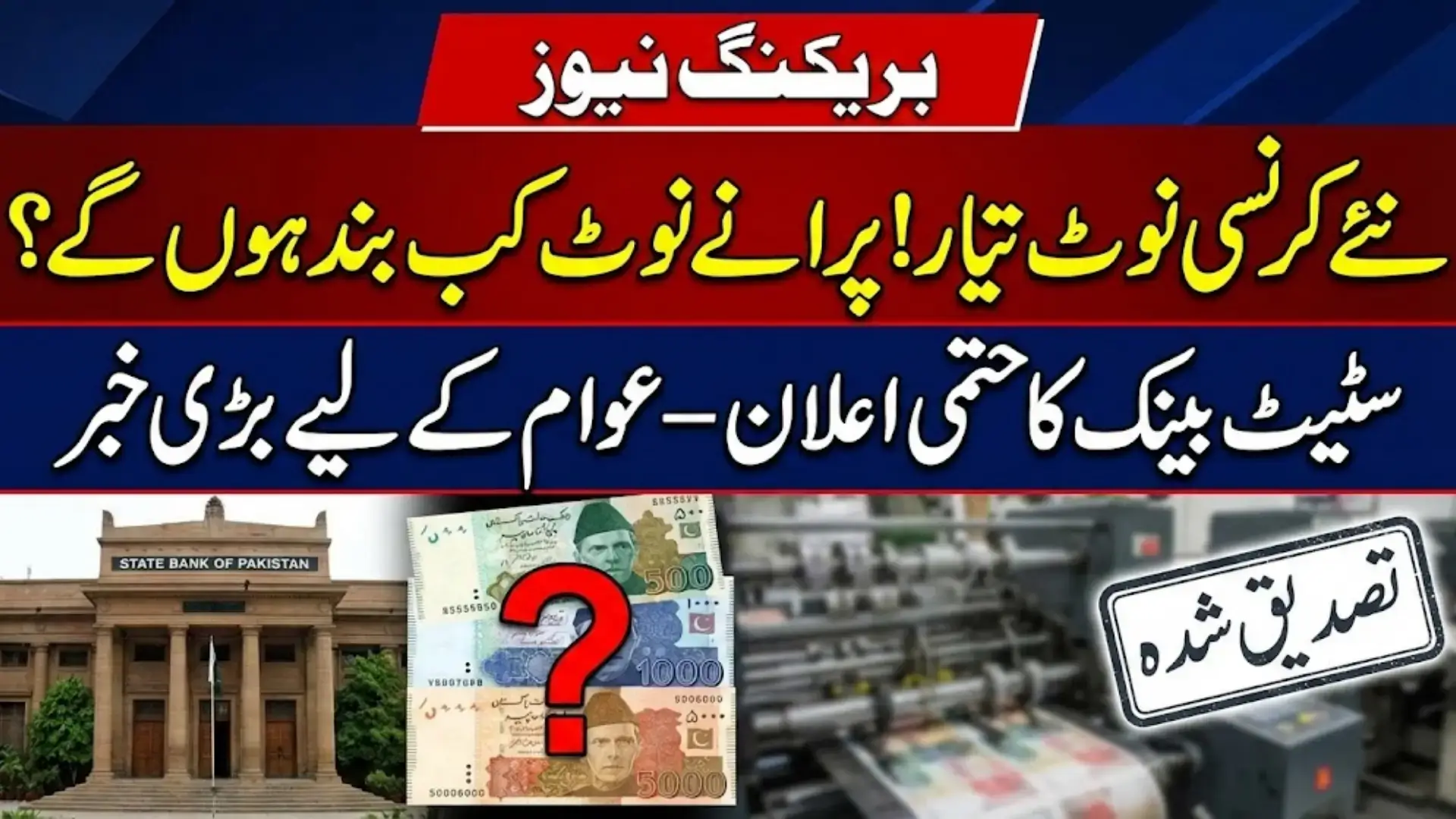
Preparation of New Currency Notes
Preparation of New Currency Notes Enters Final Stage State Bank of Pakistan has officially confirmed that the preparation of newly designed currency notes has reached its final stage. This long-awaited development was shared by SBP Governor Jamil Ahmed during a press conference held after the announcement of the latest monetary policy. According to the central bank, all technical and design-related work has been completed, and the only step remaining before printing begins is formal approval from the federal cabinet.
From what has been observed over the years, currency redesign is never rushed in Pakistan. The SBP appears to be taking a cautious and well-planned approach, keeping in mind the country’s heavy reliance on cash transactions. Rather than introducing new notes abruptly, the central bank is focusing on stability, continuity, and public convenience. For ordinary citizens, this means that while change is confirmed, daily financial life will continue as usual for now.
State Bank Confirms Final Phase
The SBP has clearly stated that the redesign process is no longer at a conceptual or discussion stage. The designs have already been finalized and submitted to the government for review. This indicates that security features, printing standards, and visual elements have been carefully examined and approved internally by the central bank.
Based on previous experiences, such redesigns involve months of coordination with security experts and printing authorities. That is why SBP officials are confident in saying that the process is now complete from their side. The bank is only waiting for the government’s final decision to move ahead.
Key points highlighted by the State Bank include:
- New currency note designs are fully finalized
- Security and anti-counterfeiting features have been approved
- SBP is operationally ready to begin printing
Federal Cabinet Approval as the Final Green Signal
The State Bank has emphasized that printing cannot begin without federal cabinet approval. The finalized designs were presented before the cabinet, chaired by Prime Minister Shehbaz Sharif, where an initial review was conducted. To further examine the matter, a dedicated cabinet committee has been formed.
This step reflects the importance of currency as a national symbol and a legal instrument. Cabinet involvement ensures that the decision carries legal backing and political consensus, reducing the risk of controversy later.
In simple terms, cabinet approval ensures:
- Legal authorization for printing new notes
- Government oversight of design and rollout plans
- Institutional consensus on a sensitive national matter
Printing of Multiple Denominations at the Same Time
One of the most important clarifications given by the SBP governor was that the printing process will not be limited to a single denomination. Instead, two to three denominations will be printed simultaneously once approval is granted. This strategy helps maintain balance in the cash supply and avoids overburdening one specific note.
From a practical standpoint, this approach supports smoother circulation across banks, ATMs, and markets. It also prevents sudden pressure on commonly used denominations such as Rs 500 or Rs 1,000 notes.
According to SBP:
- Two to three denominations will be printed together
- Printing will start immediately after cabinet approval
- Exact denominations will be announced later
Why New Notes Will Not Enter Markets Immediately
Despite the printing process being close, the State Bank has clearly stated that new currency notes will not be released into the market right away. This decision is based on experience, as sudden currency changes can create confusion, hoarding, or shortages.
The central bank wants to ensure that a sufficient quantity of new notes is available nationwide before public circulation begins. This careful planning is aimed at protecting ordinary citizens from unnecessary inconvenience.
Reasons for delayed circulation include:
- Time required to print large volumes of notes
- Nationwide distribution planning
- Ensuring smooth coexistence of old and new notes
Phased Replacement Strategy Explained Simply
Instead of withdrawing existing currency notes all at once, SBP plans to replace them gradually in phases. This means that old and new notes will circulate together for a certain period, allowing people to adjust naturally.
In a country like Pakistan, where cash is widely used for daily needs, a phased approach is essential. It protects small businesses, daily wage earners, and rural populations who rely heavily on physical money.
Under the phased strategy:
- Old notes will remain legal tender
- New notes will slowly enter circulation
- No immediate exchange deadline will be announced
Adequate Currency Stock Before Public Circulation
Another key point shared by SBP is that new notes will only be released when adequate stock is available. This ensures that banks and ATMs can meet public demand without disruption.
This policy reflects a people-focused approach. Citizens will not be forced to rush to banks or worry about cash shortages during the transition.
SBP’s stock management aims to:
- Maintain uninterrupted cash availability
- Support banks and ATM networks
- Avoid public panic or confusion
Uncertainty Around First Denominations to Be Issued
At this stage, the State Bank has not disclosed which denominations will be introduced first. Officials have deliberately avoided speculation to prevent misinformation and rumors.
Currently, all existing currency notes remain valid and usable. The SBP has reassured the public that no denomination will be suddenly withdrawn.
Currency Notes Currently in Circulation
| Denomination (Rs) | Legal Status |
|---|---|
| 10 | Valid |
| 20 | Valid |
| 50 | Valid |
| 75 | Valid |
| 100 | Valid |
| 500 | Valid |
| 1,000 | Valid |
| 5,000 | Valid |
Current Currency Notes Still Fully Valid
Many Pakistanis worry that new currency designs may make old notes unusable overnight. The SBP has firmly denied this possibility. All existing notes will remain legal tender during the transition period.
There is no need for immediate exchange, no deadlines, and no restrictions on cash usage. This assurance is especially important for people who keep savings in cash form.
Public reassurance from SBP:
- Old notes will not be cancelled suddenly
- No exchange pressure on citizens
- Daily transactions remain unaffected
Role of the Cabinet Committee
The cabinet committee formed to review the new currency designs plays an important oversight role. Its job is to evaluate technical, financial, and policy aspects before granting final clearance.
Such committees are standard practice in matters of national importance. Their involvement adds transparency and accountability to the process.
The committee is responsible for:
- Reviewing final designs
- Advising on implementation strategy
- Ensuring national interest is protected
What This Change Means for the Public
For the general public, the introduction of new currency notes is expected to be smooth and gradual. New designs usually come with improved security features, helping reduce counterfeit risks and increasing confidence in cash transactions.
From a journalistic perspective, the State Bank appears to be learning from past experiences. By prioritizing preparation over speed, it is aiming to introduce change without disturbing the financial routine of ordinary Pakistanis.
In summary, while the preparation of new currency notes has entered its final stage, their impact on daily life will be slow and controlled. Citizens are advised to stay informed, but there is no need for concern or immediate action at this stage.